DPF Cleaning and Forced Regen
Certified DPF cleaning and forced regeneration to clear derates and keep the aftertreatment system compliant.
Learn moreMobile and in shop
A fault lamp is a symptom, not a diagnosis. We read live data on the platform specific software, prove the fault on the truck, and quote the repair before we start turning wrenches.
Most engine work that arrives at our Baltimore shop starts the same way: a derate, a check engine lamp, or a driver reporting that the truck no longer pulls the way it used to. The difference between a cheap repair and an expensive one is usually how carefully the first two hours are spent. We connect on the manufacturer software rather than a generic code reader, capture live and freeze frame data, and test the components the code actually points at instead of replacing parts in sequence until the lamp clears.
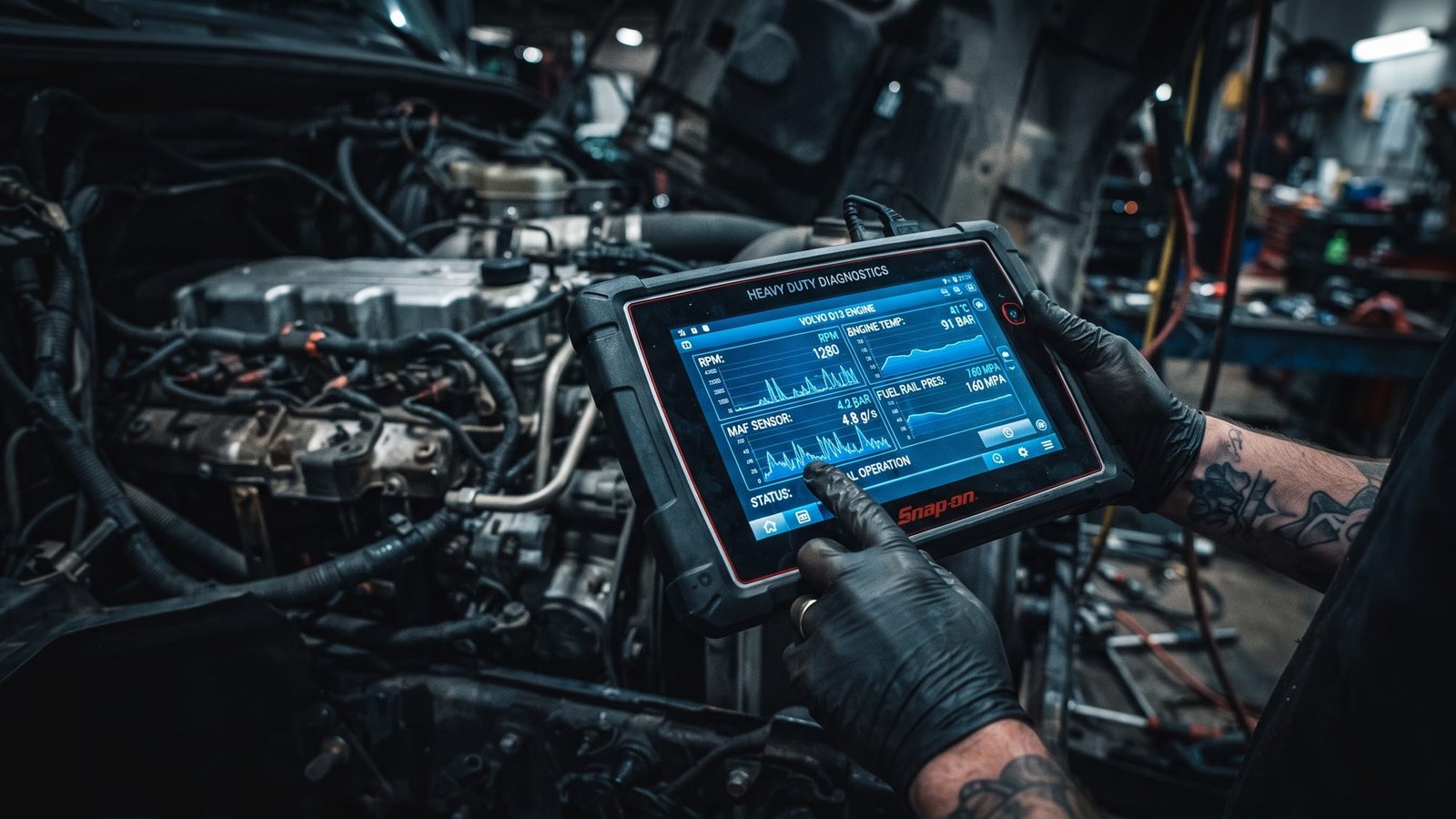
Our shop runs manufacturer level diagnostic software rather than generic readers, which is the difference between reading a code and calibrating an actuator or running a cylinder cutout test. Bays are equipped for in frame work with engine support, overhead crane access and calibrated torque tooling. Our mobile units carry laptops with the same licences, so a large share of diagnostic work is completed at your yard or on the shoulder without a tow.
Mobile and in shop
Covering Baltimore City and 29 surrounding communities, out to roughly 30 miles from the shop on Ponca Street.
See the areas we coverThe full scope of the work, so there is no ambiguity about what is and is not included when you approve a job.
If you recognise any of these, it is worth a call before it becomes a roadside call.
Check engine or stop engine lamp is on, flashing, or the truck has gone into derate
Noticeable loss of power on grades, particularly loaded and on the I-83 or I-695 climbs
Blue, white or heavy black smoke from the stack under load
Hard starting when cold, extended cranking, or the engine will not start at all
Knocking, ticking or a metallic rattle that changes with engine speed
Coolant loss with no visible external leak, or oil and coolant mixing
Fuel economy has dropped noticeably over a few weeks with no change in route or load
Engine surging or hunting at idle, or an idle that will not hold steady
The sequence matters as much as the repair. Working through it in this order is what stops you paying for parts the fault never pointed at.
We take the symptom in the driver’s own words, along with recent repairs, fuel purchases and any codes already cleared. Repeat repairs are usually a diagnosis problem, not a parts problem.
We connect on the platform specific software, pull active and inactive codes, and record live data at idle, at high idle and under load so intermittent faults are captured rather than guessed at.
Codes point at a circuit, not a part. We test the actual component, wiring and connections, using pressure tests, cutout tests and flow tests as the fault requires.
You get the failed component, the labour hours, the parts cost and any parts we recommend replacing while the engine is open. Nothing proceeds without your approval.
After the repair we clear codes, road test under real load, and rescan. If a code returns we go back to step three at our cost, not yours.
Faults rarely sit in one system. These are the ones that most often come up alongside this work.
Certified DPF cleaning and forced regeneration to clear derates and keep the aftertreatment system compliant.
Learn moreWiring faults, ECM and ECU diagnostics, lighting, charging systems and sensor replacement on tractors and trailers.
Learn moreScheduled PM services, oil and filter changes, fluid checks and DOT pre-trip inspections, on your yard or ours.
Learn moreDiesel Fault Codes That Mean Stop Driving, and Ones That Can Wait
Not every dash lamp is an emergency, and not every emergency shows a red lamp. How to tell the difference before you turn a repair into an engine.
Read the articleEngine and Emissions
Not every dash lamp is an emergency, and not every emergency shows a red lamp. How to tell the difference before you turn a repair into an engine.
4 min read
Send the unit details and the symptom and dispatch will come back to you. If the truck is off the road right now, call instead.
A form is fine for scheduling. For a truck that is stopped, a call gets a unit moving while you are still describing the problem.
(443) 630-6669Drawn from the questions we get asked most about this specific service.
A large share of diagnosis happens on site. Our mobile units carry the same manufacturer software the shop uses, so we can scan, test sensors and check fuel pressure wherever the truck is. Work that needs the engine opened up, a lift, or the overhead crane comes into the Baltimore shop.
Cummins ISX, X15, ISB and B6.7, Detroit DD13, DD15 and DD16, Paccar MX-11 and MX-13, Caterpillar C7, C13 and C15, plus Volvo D11 and D13 and International A26 and MaxxForce. If you run something unusual, call before you tow it and we will tell you honestly whether it is in our wheelhouse.
Most diagnoses run one to two hours. It is charged at our diagnostic rate and quoted up front. If you approve the repair with us, the diagnostic time is credited against the repair on the same visit.
It depends on the derate. A 5 mph speed limit derate means you are stopping where you are and calling us out. A soft derate may let you crawl in. Tell us the exact code and the dash message when you call and we will tell you which one you have.
Both. We handle liners, pistons, rings, rod and main bearings in frame, and we coordinate head machining with a local machine shop when a head needs surfacing or pressure testing. If an overhaul is not the economical call for the mileage and the truck’s condition, we will say so.
Your call, and we quote both where a credible aftermarket option exists. On injectors, turbos and emissions components we usually recommend OEM or a reman with a real warranty, because the cheap version tends to come back.
No. Clearing an active fault without repairing it puts the truck back on I-95 with a known defect and leaves you exposed on an inspection. We will tell you what the code means and what the safe options are, including whether the truck is legal to move.